From Legends to Reality: The Truth About Female Viking Warriors and Leaders
This is the third part of our three-part series on the role of women in viking life and times. Having up to now looked at women’s roles at home, legally and in religious life, let us now move on to maybe the most contentious topic surrounding women in the Viking age – their role as warriors and leaders.
For the first part follow this link to read about Viking women and their legal standing or for the second part follow this link to read about Viking women and their Power in Old Norse Society.
Viking women as warriors and protectors
The concept of shieldmaidens, women who engaged in battle alongside men, has been a topic of fascination and controversy. While sagas and poems, rich with tales of formidable women like Lagertha, Veborg or Brunhild, suggest their existence, historians and archaeologists have debated the accuracy of these accounts.
One of the most compelling pieces of evidence in this debate comes from the Birka burial site in Sweden, known as Birka grave Bj 581. Discovered in 1878, the grave contained a full set of Viking weaponry and two horses, leading researchers to initially assume the occupant was a male warrior of high status. However, a 2017 DNA analysis revealed that the skeleton was in fact biologically female.
This discovery, often referred to as the “Birka warrior grave,” has had significant implications. It challenges the assumption that all Viking warriors were male and suggests that women could hold high-ranking positions in Norse military hierarchies. Critics argue that the presence of weapons in a woman’s grave does not necessarily guarantee her status as a warrior, going as far as suggesting that the grave could have had a second occupant.
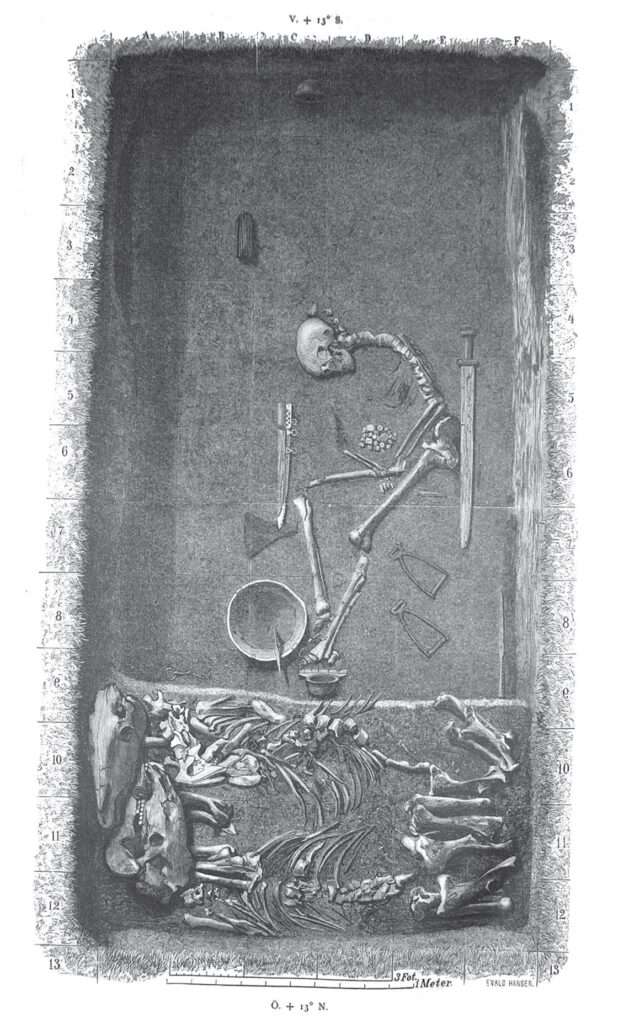
Even if the presence of burial artifacts does not directly mean the woman in the grave was a warrior, there was a well-known old Norse custom of burying people with artifacts from their life which they could use in the afterlife. It is therefore unlikely that the woman in the grave did not know how to properly wield weapons, as she is buried almost exclusively with items considered related to warfare. Normal viking women graves would mostly contain tools related to “traditional” women trades and household goods, as well as jewelry, which the Birka grave is mostly devoid of.
-
 Select options This product has multiple variants. The options may be chosen on the product pageQuick View
 -
Quick View


The Goddess Freya is also a strong female character believed to be associated with war. Modern pop culture references to vikings is rife with references to warriors dying and going to Odin’s Valhalla. The poem Grímnismál however, states that Freya chooses half of the warriors slain in battle to take to Fólkvangr and Sessrumnir, and the remaining half belongs to Odin. Even though the canon of old Norse prose and poetry is rife with contradictions and ambiguities, at least according to this poem the primary deity controlling the fate of warriors is Freya and whoever she did not choose are the ones who ended up in Valhalla. It should be noted that accounts of Freyja’s actions during Ragnarök are scarce, where Odin in comparison is directly said to lead his half of the fallen, known as Einherjers, into the final battle. The implication is however likely that Freyja will lead her warriors into battle, like Odin even if this is not directly written in the sources, as all will perish during the end times.
Interestingly too, the Valkyries – valkyrja, meaning “chooser of the fallen” from “valr”, meaning someone slain in battle, and “kjósa”, to choose – are female figures sent out by Odin to collect his half of the warriors fallen in battle to take them to Valhalla. While strictly mythological, the Valkyries can be interpreted as a societal acknowledgment of women’s capacity for combat and leadership. The existence of Valkyries in Norse lore suggests an undercurrent of respect for warrior-like qualities, irrespective of gender. This fusion in the portrayal of Valkyries could indicate that, contrary to conventional views of passive femininity, Viking culture harbored a nuanced perspective on women’s roles. While the historical accuracy of women serving in combat remains debated, the cultural impact of the Valkyries is unmistakable and they embody a powerful archetype of female warriors.
The importance and reverence of the Valkyries also goes far beyond sagas and stories and drift into the daily life of vikings. A common belief held in old Norse time was the idea of a guardian spirit called a “fylgja” or the related spirit “hamingja”. These were both protective spirits that followed you in your day-to-day and were an intricate part of your luck and future. The hamingja is interpreted as a female guardian spirit or a goddess of good luck who would invisibly guide you to towards good fortune. The fylgja on the other hand was generally believed to be a more domineering force. Fylgja directly translates into “support” or “follower”, but contrary to the translation the spirit was normally believed to walk directly in front of its protector where it could harm enemies and evil forces it encountered.
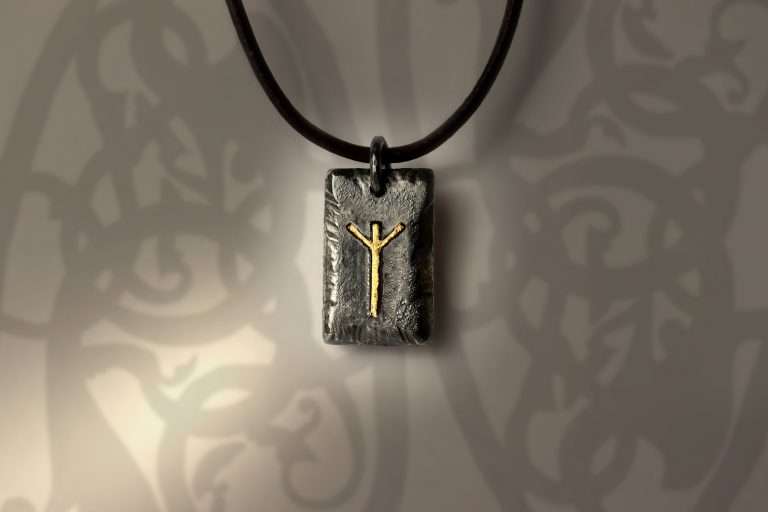
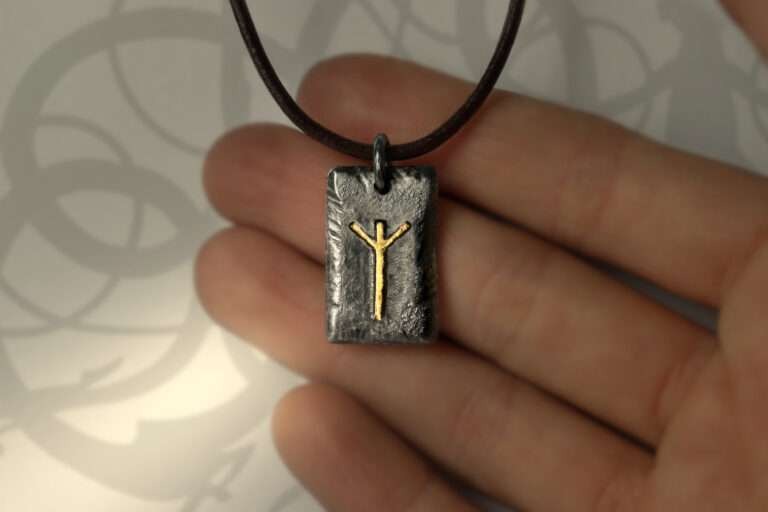
Juxtapose this with the stories about how the Valkyries would come to warriors’ aid on the battlefield and we begin to see the outlines of a larger idea of strong, dangerous female protectors seeping through the belief system of the Vikings. For example in Helgakviða Hjörvarðssonar the valkyrie Sváfa would protect Helgi from danger, or in Sigrdrífumál, where the valkyrie Sigrdrífa – literally meaning “victory-driver” – aided Sigurðr. These stories were likely deeply ingrained into common belief – going as far as people wearing talismans of the Valkyries, such as the Valkyrie talisman found in Hårby, likely in an attempt to invoke the aid of the valkyries or similar protective spirits.
Another curious mention of female warriors come from Adam of Bremen in his Gesta Hammaburgensis. He mentions how the Amazons – the female warriors known from Greek Mythology – can be found inhabiting the shores of the Baltic Sea, near Sweden (not far from Birka), called terra feminarum – land of women. According to Adam of Bremen, the women here are impregnated by sipping water, by passing merchants, by their male captives or by monster – which Adam believes is the most likely – and when they give birth to offspring of the male gender they are cynocephaly – men with heads on their chest and who bark. Equally, they drive away men who approach and are said to have killed king Anund and his army by poisoning their water source. However, beyond this Adam of Bremen mentions nothing more, but the stories of Amazons and their prowess as warriors was well-known in Southern Europe at the time. One can therefore speculate that Adam of Bremen localizes the Amazons in the north, at least partially due to stories from the north of female warriors.
This story however also demonstrates a clear problem with our understanding of women in Viking society when looking at literary sources. Likely, Adam of Bremen, who was sent by the church to chronicle the doings of the Hamburg-Bremen diocese, is using the Amazons as an example of how barbaric and incomprehensibly savage the people in the North were. The idea of women as fierce warriors living in their own society and the warped gender roles this entails, was likely equally as disturbed as the women having relations and giving birth to monsters. Normative ideas like these have equally colored our perception of women in viking society, all the way up to current day.
Women in Power
While the the mythological stories are rich with strong female characters, history too provide numerous real-life equivalents.
As strategists
Åsta Gudbrandsdatter was the mother of King Olav II – more famously known as Saint Olaf – and King Harald III – known as Harald Harada. Åsta is a great example of how women could wield strategic power and influence.
Åsta Gudbrandsdatter was married to the ruler of Vestfold, Harald Grenske. When Harald was killed by Sigrid the Haughty, together with another of her suitors, after trying to marry her. Upon finding this out Åsta Gudbrandsdatter returned to her native Oppland, where she has a son whom she named Olaf, before marrying Sigurd Syr, the king of Ringerike.
Åsta Gudbrandsdatter’s importance first becomes evident when she in 1007 arranges for her son Olaf, aged twelve, to go on his first expedition. Custom at the time dictated that a captain of noble heritage be automatically given the title “King”, meaning Olaf would be known as King Olaf even without controlling any land. After successfully returning home, Olaf would continue to consult with his mother on military affairs, and it eventually led to him becoming one of the mightiest Kings in Norway’s history.
The probably most significant woman in this regard is Gunnhildr Gormsdóttir, also known as Gunnhildr konungamóðir – Gunnhild, Mother of Kings. Gunnhild was likely the daughter of Gorm the Old, the king of Denmark, however different sources attribute her with different parents. What we do know for certain is that she was the wife of Eric Bloodaxe, the king of Norway. Her name arises from the fact that she was the mother of Gamli Eiríksson, a Norwegian ruler, and Haraldr gráfeldr, a king of the West of Norway, as well as several other sons who challenged the rule of Haakon the Good, who took over the rule of Norway after their father, and would later mortally wound him at the battle of Fitjar. Because of her involvement in her sons’ campaigns Gunnhild is probably one of the most mentioned women in all the sagas, and her name is mentioned in four chapters of Heimskringla as well as Fagrskinna, Egils saga and Njáls saga – clearly alluding to her historical impact.
It should be noted that the concept of a Queen was not very prevalent in old Norse society, and instead the king’s mother’s were usually considered more influential. This is probably partially due to the significance of heritage and bloodline, where one’s parents were a significant factor in determining ones future – being of a good bloodline opened up more avenues for influence. Gunnhild seems however to have had significant influence both as a Queen during Eric Bloodaxe’s reign, and as the mother of the “Eric-sons”.
Another significant female strategist was Åsa Haraldsdottir, the daughter of king Harald Granraude. The sagas tell that Gudrød the Hunter, the king of the Norwgian region then known as Borre, wanted to marry Åsa. Åsa’s father subsequently refused the proposal, which led to Gudrød to killing both Åsa’s father and brother, before kidnapping and marrying her. Their relationship gave her one son, Halfdan the Black, before Åsa had Gudrød killed as revenge. She then went back to her native Agder where she took power and ruled for 20 years, before leaving the throne to her son Halfdan. Halfdan, a significant ruler in his own right, would later have a son Harald Halfdansson, later known as Harold Fairhair, the first king of the united Norway as mentioned earlier.
Archaeological evidence
Generally speaking we have little direct evidence which can help us relay the importance of women in the Viking age, except for the archaeological finds which help shed light on a poorly lit part of history.
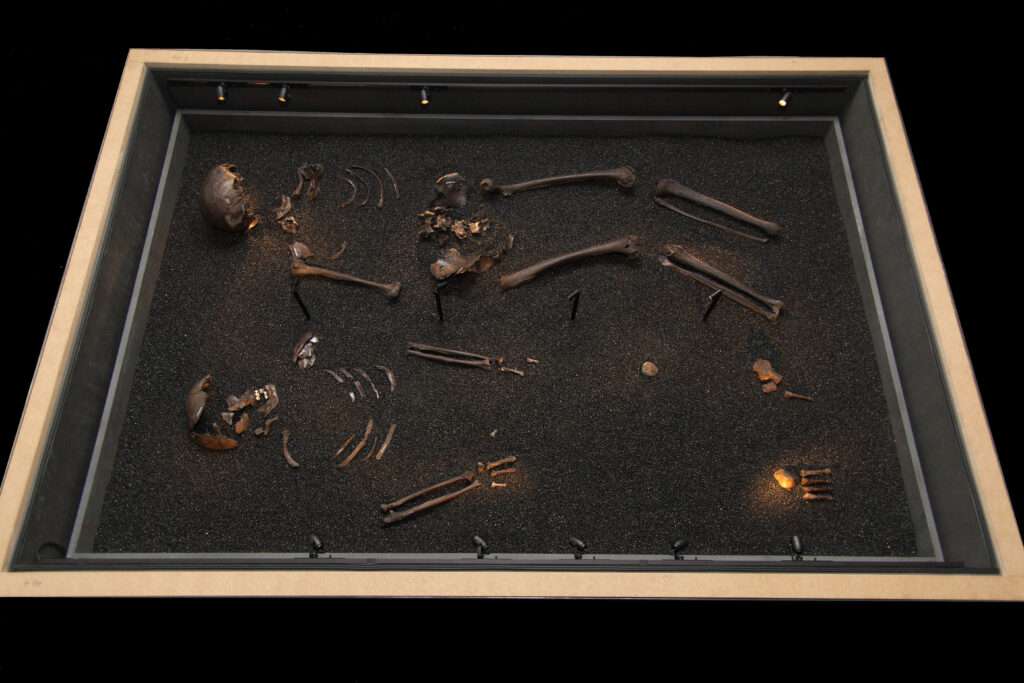
In this regard, the most extensive Viking burial site found up to this date is the Oseberg Ship burial, which has contained some of the best preserved and extravagant relics from the Viking age. The burial site contained two women, an older woman aged around 80 and a younger woman aged in her early 50s. Not only does the grave goods contain a full ship, 14 horses, and ox and three dogs, it contained several beautifully decorated artifacts. Unfortunately the grave had been disturbed so all precious artifacts had been removed, leaving only behind large and everyday items. The extravagance of the burial implies the extremely important position of the woman or women in the grave. Carbon dating has dated the grave to the autumn of year 834, which would align with the life and death of Åsa Haraldsdottir above, which has been suggested as the person in the grave. However, a lot of controversy surrounds this conclusion, and another suggestion has been that the grave was that of a priestess or volva. Irrespective of who the grave actually belongs to, it is a testament to the social standing and significance of the women in the grave, and equally reflects the reverence awarded women both in society and in death.
It should be noted that suggestions have been made that the Oseberg ship burial is in fact the burial of a man, whose body was removed during the burial plundering dated to the year 953. However, very little evidence past a willingness to attribute the burial to a man, rather than a woman, of significance seems to support this thesis.
Conclusion
As most of our current accounts of the vikings and old Norse society were written down centuries after they happened the accuracy of the sagas and their content will forever remain a question of doubt. Viewing the sagas in a light partially reflecting the pre-christian society they actually depict and partially reflecting the Christian time they were written down in is likely our best bet when analyzing the limited information available to us. Similarly will certain tales likely have been exaggerated while others will likely have been understated in an attempt to relate history to an audience already partially knowledgeable about it, but who inhabit a society very different from whatever came before it. Therefore, getting an accurate view of the intricate functionings of society from that time, let alone trying to interpret women’s implicit role in that society becomes a difficult task marred by interpretation, guesswork and current-day implicit bias.
The truth is that many researchers and commentators have their own incentives to take one or the other side in the debate surrounding women’s roles in the Viking age. From a feminist standpoint, arguing that Viking women were still subject to male rule and that women has always been the victims of a patriarchal system has its own attraction. Equally, from a traditionalist, ideological or religious perspective, being able to project ones own morals onto earlier societies helps build a legitimacy around ones own supposedly righteous ethics as an enduring fundamental truth inherent in human nature. Either way it opens up the avenue to disregard true fundamental facts and not view evidence presented in the simplest, direct view. To argue that the woman buried in the Birka grave was not a warrior, or to downplay the importance of the women found in the Oseberg burial by inventing a third, missing male body, seems like an affront to history.
Viking society was in no way an equal society the way we would see it today. It was clearly delineated along ideas of gender roles and their positions within society. However, Viking society was one nuance where women played a much greater role in society and had more influence over their own lives than women would in Europe over the next 800 years. Viking women played an essential role, extending far beyond the normal ideas of women as householders and gatherers.
Still, Viking society should in no way be a guiding star for the ideas in current society, but as an historical artifact, old Norse ideas on female roles provides us with a richer, more textured understanding of the past, and perhaps, a guide for rethinking the narratives we’ve inherited about gender, power, and honor.