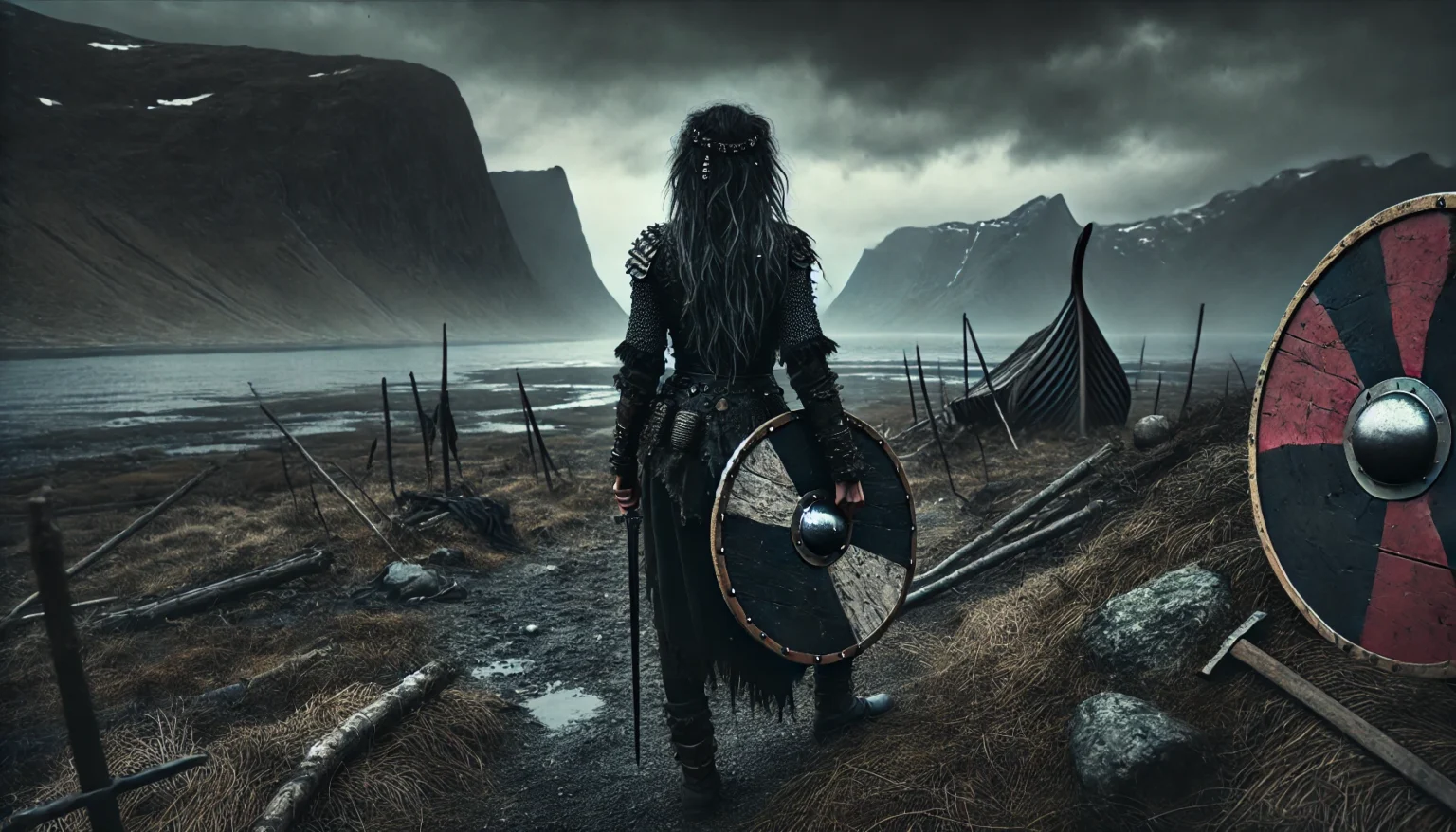
Viking women: Unveiling the Power of Women in Old Norse Society
This is the second part of our three-part series on the role of women in viking life and times.
For the first part follow this link to read about Viking women and their legal standing or for the third part follow this link to read about Viking women leaders and warriors.
Having discussed women’s position in the family and as singular legal entities we now shift our focus towards women’s power and roles in a larger, societal context as religious figures and economic actors.
Religious and Cultural Life
Looking past the modern, hollywoodesque view of the old Norse pantheon of gods, usually only centered around Odin and Thor, there exists an extensive cast of major and minor gods who occupy essential roles in the mythology – several of whom are female.
Freyja
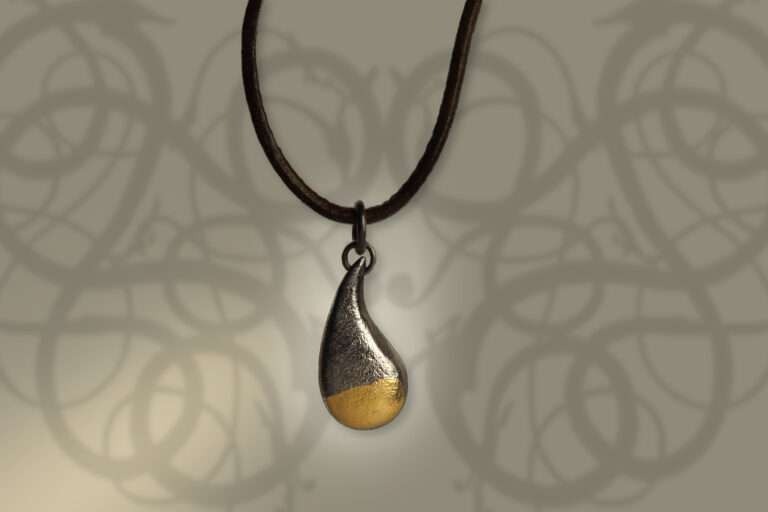
The most significant of these is probably Freyja, (also spelled Freya or Freja), meaning “Lady”, who is associated with love, fertility and war. She is also the main deity associated with seidr or magic. In many ways, the qualities attributed to Freyja seem quite contradictory – love and war is generally not considered compatible, but it is also possible to argue that Freyja’s dual nature mirrored an ideation of women as both nurturers and warriors.
-
 Quick View
Freyja’s mythological narratives often also highlight her independence and strategic acumen, qualities that resonate with the Viking’s general ideals of strength and determination. Despite her association with traditional feminine attributes of beauty and desire, Freyja is not a passive figure and is depicted as decisive and bold, capable of fierce autonomy and emotional expression.
Frigg
Frigg is another prominent female deity in Norse mythology, and very often mixed with Freyja. She is the wife of Odin and is associated with marriage, motherhood, and domesticity. She also strongly exemplifies the idealized protective nature of women, where as the mother of Baldr she makes every thing in the universe promise not to hurt her son. Baldr is later killed by Loki, who tricks Hod into shooting hin with an arrow made of mistletoe, the only thing Frigg forgot to ask to promise to protect Bladr – known as Frigg’s first sorrow. Later, her grief over Odin’s prophesied demise becomes her second sorrow. These references emphasize her extensive role in Norse cosmology and her deep maternal grief.
In Grímnismál, Frigg plays a key part in the prose introduction, fostering a young boy named Agnar, again showcasing her nurturing and protective nature. In Lokasenna, Frigg’s presence at a banquet leads to a heated exchange with Loki, revealing her strength and prominence among the gods. While the Prose Edda further details Frigg’s attributes, emphasizing her wisdom, foresight, and status as the highest of the goddesses, second only to Freyja. Friday is equally named after her (or possibly Freyja), where the old English frīġedæġ translates into “Frigg’s day”, further exemplifying her significance to the Vikings.
Iðunn
Iðunn in Norse mythology is the keeper of apples that grant eternal youth to the gods. In Skáldskaparmál, Iðunn is kidnapped by the goddess Skaði’s father, Þjazi, who takes both her and her apples to his home Þrymheimr, with Loki’s help.
As the sole sustainer of the God’s youthfulness, she embodies the theme of rejuvenation and preservation, and as such also reflects the traditional view of women as life-givers and custodians of health and wellness within the family. Her role accentuates the importance of women in nurturing and sustaining the health and continuity of the community. She is also attested in the poem Lokasenna, where she talks down her husband Bragi from attacking Loki when he insults both him and Iðunn. As such she likely also reflect an ideal of the woman as calm and reasonable, as opposed to the men who are often described as hot-headed and brash.
Skaði
Skaði is another interesting goddess in her own right. After the gods kill her father she marries Njörðr as part of the compensation. She is later said to have married Odin, with whom she had several children. Skaði is associated with skiing, winter and mountains, but most interestingly also bowhunting. Today we often view earlier societies as communities built by hunterers, the men, and gatherers, the women. In this regard, Skaði stands in stark contrast to the traditionalist idea of old Norse society fitting into this classification, possibly also reflecting a wider view of women having roles far outside the household.
Her name is also partially believed to be associated with the great female warrior Scáthach known from irish mythology, further strengthening her associations with values traditionally attributed to men. Her name might also be associated with the later term “Scandinavia”.
Beyond the goddesses mentioned above, the stories are filled with significant female deities, personifying possibly some of the most important objects to the Norse. For example, Sól, the personification of the sun, Þrúðr, the valkyrie, whose name simply means strength, Vár, whose name means pledge or oath, or Rán, who together with her husband Ægir, is a personification of the sea.
The old Norse pantheon is filled with significant female characters, reflecting a broad set of values and attributes, many maybe less commonly associated with female characteristics today.
Volvas
Possibly some of the most fascinating female characters in the Viking chronicles are the volvas and seidkonur, both terms for old Norse Viking seeresses. Generally, the volvas seem to have been travelling sorceresses, moving around and offering their services to peer into the future. For example in the Saga of Erik the Red, the volva is sent for as she is visiting another farm nearby, for her to come to their winter feast so she can foretell the future and tell them when their famine will end. The same scene also plays out in many of the other sagas. Being offered to a feast like this would in most regards be considered a gesture extended only to those of a significant social standing, and it has been suggested (Eva Marie Goransson, 1999) that the volvas held a higher social standing than women generally.
Furthermore, in some instances they seem to be explicitly paid for their services as well as being left with gifts. To some extent this might be related to the belief that the volvas could not just look into the future, but also shape it. If this was the case you would do best to please them, in hopes that they would shape your future to the best of your interest. But it also reflects the reverence the volva’s work commanded as spiritual guides.
This religious or cult-ish reverence is something that completely disappears after the introduction of Christianity, where up until recently (and only in certain sub-branches of Christianity) the priesthood has been exclusively male.
Economic and Social Contributions
Viking women as explorers
During the Viking Age, exploration was not solely the domain of men. Women, too, played significant roles in the voyages and settlements that spanned across Europe, Greenland, and even North America. While traditional narratives have often sidelined their contributions, the role of women in the expansion of Viking society cannot be overlooked. Their contributions were not only supportive but integral, as they were part of the groups that established new settlements, maintained cultural practices, and facilitated community cohesion in unfamiliar lands.
One of the most famous female figures from this era is Aud the Deep-Minded, a noblewoman who, after the death of her husband and son, embarked on a journey from Caithness in Scotland to Iceland. Aud has a knarr built in secrecy before captaining it via Orkeny and the Faroes, to Iceland, where upon her arrival she became one of the first settlers, distributing land among her crew.
Another example of female exporers is Gudrid Thorbjarnardóttir, known as “víðförla” meaning far-travelled. Gudrid’s life story, detailed in the Saga of the Greenlanders and the Saga of Erik the Red, showcases her extensive voyages that took her together with her husband from Norway to Greenland, and then to Vinland, present-day Newfoundland, Canada. She is equally recognized as the first known European woman to give birth in North America.
Freydis Eiriksdottir, the daughter of Erik the Red, stands out as a particularly bold explorer. Accounts from the Saga of the Greenlanders describe her voyage to Vinland after her brother, Leif Erikson, who is credited as the first European to set foot on the North American continent. Freydis was therefore likely one of the first European women to set foot in America, and most definitely the first female captain to lead an expedition there.
These are just a few direct examples of women taking leading roles in the expansion of the Vikings. However, plenty evidence exists to suggest women – and also children – were aboard ships during the exploration of the Vikings. Irrespective of how you measure their impact, whether as captains or leaders, the ultimate truth is that women provided an integral role in re-establishing and maintaining a functioning society during the settlement process of the Vikings. So to talk about the pursuit of vikings as being a purely male undertaking fails to properly address the evidence from the time.
Home economy
Probably one of the most stereotypical view of viking women is as providers and managers of the home while the men were out raiding. This can likely partially be attributed to a general view of the Vikings as a band of masculine/male warriors, perpetuated by an ideological willingness to amplify these images. Even still we cannot disregard the importance women held in this regard.
Viking women were the cornerstones of the household economy. A woman’s life in old Norse society seems to have centered around household chores, including cooking, child-rearing and farming. This is evident from the burial goods found in female graves, which mainly contained household items. However, the importance of farming and animal husbandry was completely essential to survival in old Norse Scandinavia cannot be understated. Women were the key to sustenance farming, ensuring that food supplies remained constant throughout the year. They cultivated crops, managed livestock, and preserved food for the harsh winters.
The idea of women as the head of the household goes so far as to suggest women were sole rulers of anything within the four walls of the home. This power has most often been symbolized by keys and women carrying the keys of the house on their belt. From the sagas this power over the home seem in most circumstances to have been irrefutable. For example in Laxdæla saga Thorolf commits murder and flees to one of his relatives, Vigdis. Vigdis lets Thorolf into her home and locks him into a shed, before telling her husband about it. Her husband, Thord, clearly concerned knowing full well they might be considered accomplices to the crime if they are discovered as harboring Thorolf, has no choice but to let him stay, as Vigdis is the one in charge of the household. A similar theme can be found in the saga Sörla þáttr
Archaeological evidence also suggest that textile production was a mostly female undertaking. Women were skilled weavers, creating everything from everyday garments to elaborate tapestries. Their work was not only essential for clothing, an obviously essential item to stay warm during Scandinavian winters, but it was also used to make sails for longships, integral to Viking exploration, raiding, and trading ventures. However, an almost equally important use of textiles was directly as a tradeable good. Textiles were among the items traders exchanged abroad, making women’s craftsmanship an essential element of the Viking economy, which often revolved around trading with people far away.
Even though we have little written evidence describing the trading and business practices of women during the viking age, archaeological evidence, such as scales and weights found in women’s graves, suggests their active participation in commerce. In the absence of their husbands, women were most definitely expected to take care of their husband’s trade, the same way they managed the home. Their responsibilities did likely not end just there, but women were likely also expected to be able to defend their property and children from strangers.
Conclusion
Looking deeper at the roles and influences of women in old Norse society, it becomes evident that their contributions were not confined to the domestic sphere. Women in Norse mythology mirror these roles, embodying both nurturing and protective qualities, while also holding significant sway in cultural and religious realms.
Goddesses like Freyja and Frigg, often depicted with significant agency and autonomy, reflect a society that recognized and valued the complex roles women could hold. Equally, their qualities and attributes challenge the typical confines of femininity – their stories reflecting an acknowledgment of women’s capacity for leadership and influence beyond what we might expect based on traditional gender roles.
In essence, the narratives of these goddesses and the respect given to them suggest a nuanced recognition of women’s roles in Viking society—as leaders, caregivers, and warriors. This broader appreciation of women’s capabilities likely influenced the societal norms and expectations of Viking women, granting them a degree of respect and autonomy that was progressive for its time.
These ideas we will discuss further in Part 3 where we go From Legends to Reality.